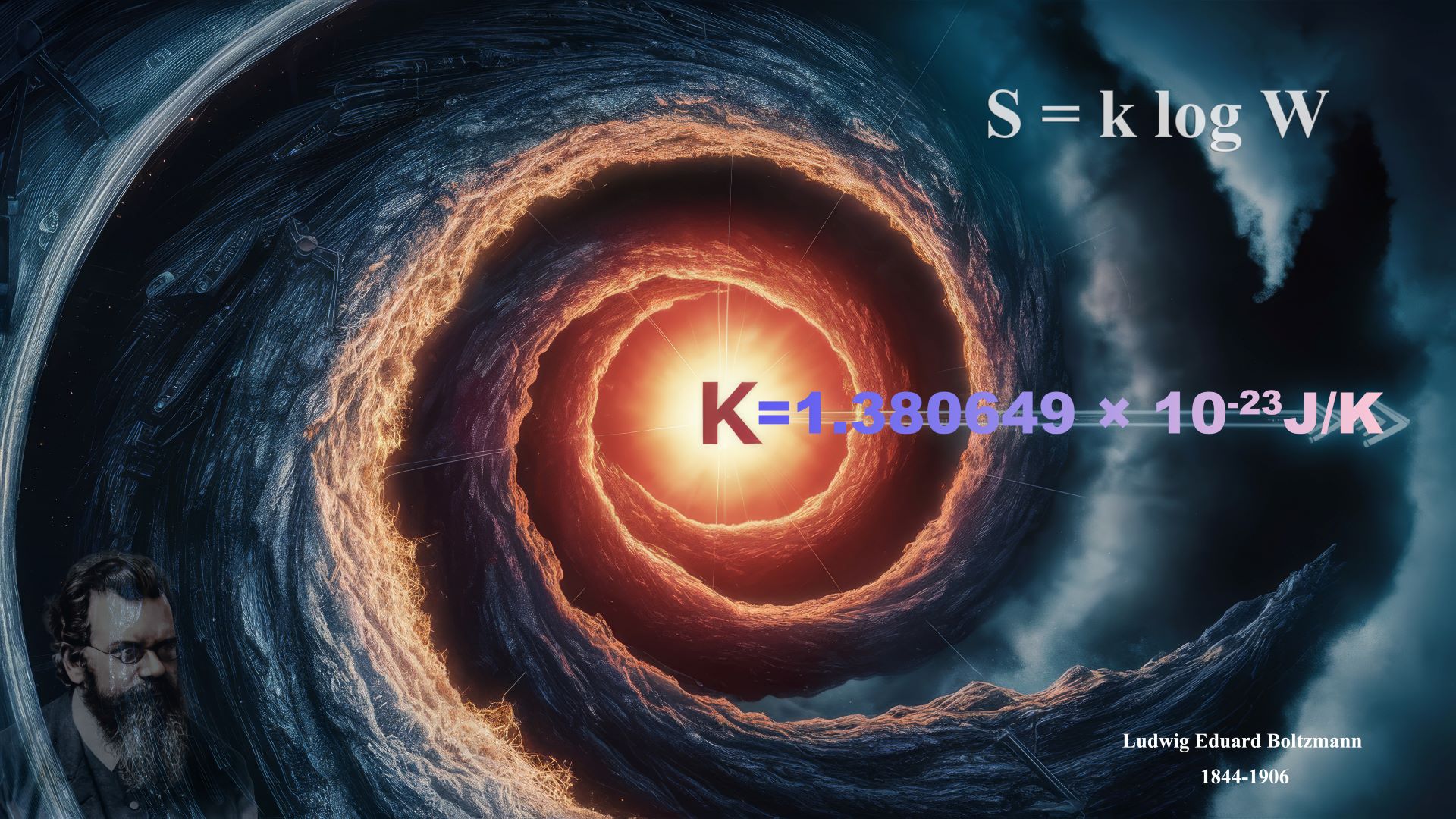
The Boltzmann constant (kB or k) is the proportionality factor that relates the average relative thermal energy of particles in a gas with the thermodynamic temperature of the gas. It occurs in the definitions of the kelvin and the gas constant, and in Planck's law of black-body radiation and Boltzmann's entropy formula, and is used in calculating thermal noise in resistors. The Boltzmann constant has dimensions of energy divided by temperature, the same as entropy. It is named after the Austrian scientist Ludwig Boltzmann.
As part of the 2019 redefinition of SI base units, the Boltzmann constant is one of the seven "defining constants" that have been given exact definitions. They are used in various combinations to define the seven SI base units. The Boltzmann constant is defined to be exactly 1.380649 × 10^-23 J⋅K^-1.
Given a thermodynamic system at an absolute temperature T, the average thermal energy carried by each microscopic degree of freedom in the system is (1/2)kT (i.e., about 2.07 × 10^-21 J, or 0.013 eV, at room temperature). This is generally true only for classical systems with a large number of particles, and in which quantum effects are negligible.
In classical statistical mechanics, this average is predicted to hold exactly for homogeneous ideal gases. Monatomic ideal gases (the six noble gases) possess three degrees of freedom per atom, corresponding to the three spatial directions. According to the equipartition of energy this means that there is a thermal energy of (3/2)kT per atom.
Combination with the ideal gas law shows that the average translational kinetic energy is (3/2)kT.
Considering that the translational motion velocity vector v has three degrees of freedom (one for each dimension) gives the average energy per degree of freedom equal to one third of that, i.e. (1/2)kT.
More generally, systems in equilibrium at temperature T have probability Pi of occupying a state i with energy E weighted by the corresponding Boltzmann factor:
Pi = exp((-E)/(kT))/Z
where Z is the partition function. Again, it is the energy-like quantity kT that takes central importance.
In statistical mechanics, the entropy S of an isolated system at thermodynamic equilibrium is defined as the natural logarithm of W, the number of distinct microscopic states available to the system given the macroscopic constraints (such as a fixed total energy E):
S = k ln W
This equation, which relates the microscopic details, or microstates, of the system (via W) to its macroscopic state (via the entropy S), is the central idea of statistical mechanics. Such is its importance that it is inscribed on Boltzmann's tombstone.
The Boltzmann constant is named after its 19th century Austrian discoverer, Ludwig Boltzmann. Although Boltzmann first linked entropy and probability in 1877, the relation was never expressed with a specific constant until Max Planck first introduced k, and gave a more precise value for it (1.346 × 10^-23 J/K, about 2.5% lower than today's figure), in his derivation of the law of black-body radiation in 1900–1901. Before 1900, equations involving Boltzmann factors were not written using the energies per molecule and the Boltzmann constant, but rather using a form of the gas constant R, and macroscopic energies for macroscopic quantities of the substance. The iconic terse form of the equation S = k ln W on Boltzmann's tombstone is in fact due to Planck, not Boltzmann. Planck actually introduced it in the same work as his eponymous h.
In versions of SI prior to the 2019 redefinition of the SI base units, the Boltzmann constant was a measured quantity rather than a fixed value. Its exact definition also varied over the years due to redefinitions of the kelvin and other SI base units.
In 2017, the most accurate measures of the Boltzmann constant were obtained by acoustic gas thermometry, which determines the speed of sound of a monatomic gas in a triaxial ellipsoid chamber using microwave and acoustic resonances. This decade-long effort was undertaken with different techniques by several laboratories; it is one of the cornerstones of the 2019 redefinition of SI base units. Based on these measurements, the CODATA recommended 1.380 649 × 10^-23 J/K to be the final fixed value of the Boltzmann constant to be used for the International System of Units.
| Value | Units | Comments |
|---|---|---|
| 1.380 649 × 10^-23 | J/K | SI by definition, J/K = m^2⋅kg/(s^2⋅K) in SI base units |
| 8.617 333 262 × 10^-5 | eV/K | (k/h) * |
| 2.083 661 912 × 10^10 | Hz/K |